E-commerce · Acquisition · Shopify · Wholesale · Local

Drip n’ Dip: Acquired a Closing Family Business and Scaled It 5x

How I bought a struggling Sacramento candy business to keep it from closing, built its first real online presence, and grew monthly revenue from $1K to $5K while landing four wholesale accounts.

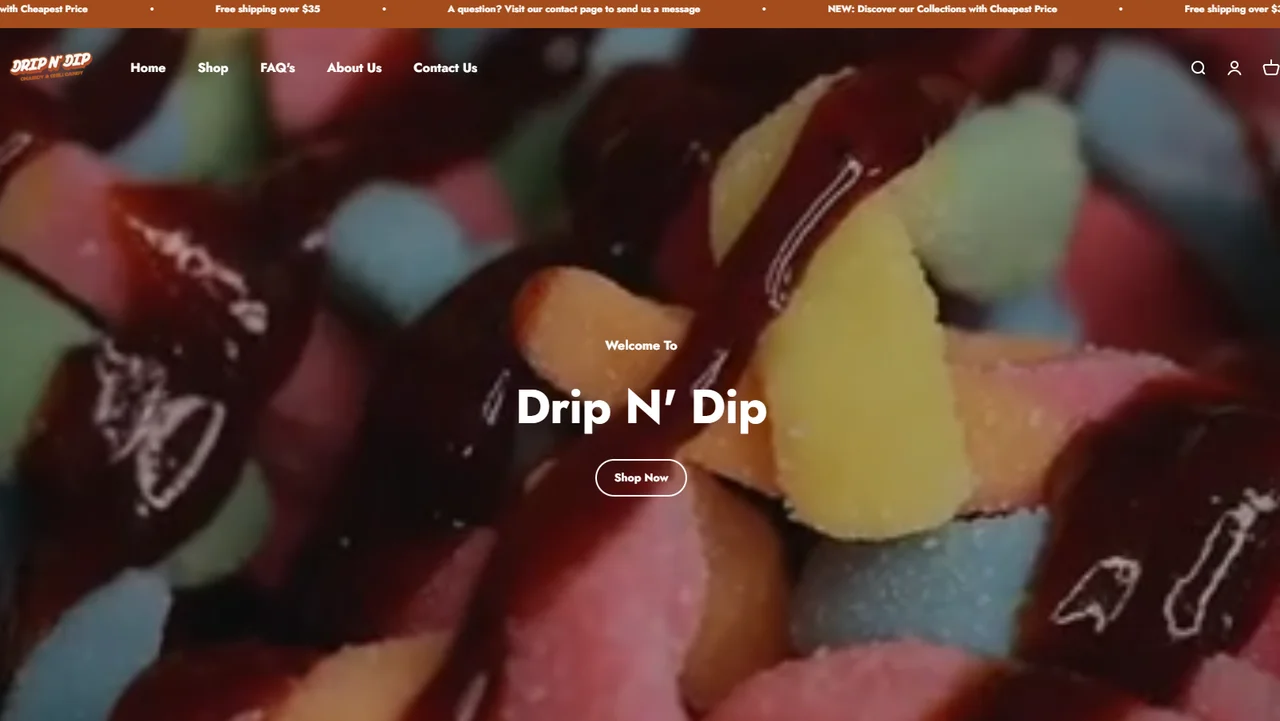
Drip n' Dip storefront
5x
Monthly Revenue Growth
4
Wholesale Accounts
400%
Online Sales Growth
20%
Delivery Cost Reduction

Overview

In January 2024 I acquired Drip n’ Dip, a small family-owned Sacramento candy business that was about to close. The previous owner was stepping away due to a pregnancy, and the business, profitable in its retail moment but with no digital footprint, was on track to disappear. I bought it to keep it open and to take a real swing at scaling a small physical-product business end-to-end.

Over the next 18 months I rebuilt operations, stood up the brand’s first functional Shopify storefront, opened a wholesale channel from zero, and grew monthly revenue 5x. The business is currently winding down as I transition ownership and refocus on full-time e-commerce work, but it remains operational and profitable.

Background

  • Family-owned Sacramento candy business specializing in retail candy and ice cream.
  • Previous owner facing closure due to pregnancy and lack of digital presence.
  • Acquired by me in January 2024 to keep the business operating.
  • Existing customer base from foot traffic and local pop-up events.

The Challenges

  • No e-commerce infrastructure, Shopify nonexistent or unused.
  • Zero wholesale relationships.
  • ~$1K/month revenue baseline.
  • No paid acquisition channels of any kind.
  • Inventory and supply-chain inefficiencies inherited from prior operations.
  • No digital brand or customer database to build on.

Goals

  • Prevent closure and keep the family-owned business operating.
  • Build out e-commerce as a meaningful, repeatable channel.
  • Establish wholesale distribution into local retail.
  • Scale to a sustainable monthly revenue baseline.

The Approach

Four phases over 18 months: stabilize the business, build digital, open a wholesale channel, and tighten operations.

Phase 1: Stabilize

  • Took full operational ownership across retail, wholesale, and e-commerce.
  • Audited existing inventory, suppliers, and customer base.
  • Documented current cost structure and margin per SKU.

Phase 2: Build digital presence

  • Built out the Shopify storefront with optimized product listings.
  • Implemented a paid social acquisition strategy targeting local Sacramento buyers.
  • Set up email and SMS marketing for repeat purchase and pop-up announcements.

Phase 3: Wholesale channel

  • Direct outreach to local supermarkets, gas stations, and specialty retailers.
  • Negotiated terms and built repeatable order-fulfillment processes.
  • Closed four accounts: Welco Supermarket, Mail N More, Vinai Wholesale, and gas-station distribution.

Phase 4: Operational streamlining

  • Renegotiated carrier rates and consolidated delivery routes.
  • Reduced delivery cost by 20%.
  • Tightened inventory cycles to reduce dead stock and improve cash flow.

The Results

  • Monthly revenue scaled 5x, from approximately $1K to approximately $5K.
  • Wholesale channel built from zero to four active accounts.
  • 400% growth in online sales since acquisition.
  • 20% reduction in delivery costs through carrier and route changes.
  • Business kept operating instead of closing.

The Wind-Down

I’m currently transitioning ownership of Drip n’ Dip so I can refocus on a full-time e-commerce career. The business remains operational and profitable through the handover.

The reason this is on the site instead of buried: it’s a real, end-to-end operator project. Acquisition, e-commerce build, wholesale outreach, supply-chain ops, and a clean exit. That’s the kind of full-stack ownership I bring to W2 work.

Lessons

Acquisition unlocks asymmetry. Buying a going concern at the right price, even a small one, skips the months of cold start that kill most new physical-product brands. The customer base, the supplier relationships, the local recognition: that’s leverage you can’t build from scratch in 90 days.

Small e-commerce is a systems problem, not a creative one. The thing that moved revenue 5x wasn’t a viral campaign. It was a working Shopify, a tight email/SMS loop, and consistent paid social to local audiences. Boring, repeatable, measurable.

Wholesale is a different sport. Direct outreach, terms negotiation, and reliable fulfillment matter more than marketing. Once you’re on the shelf, the marketing job is keeping the buyer happy enough to reorder.

Like to chat about acquisition or scrappy e-commerce growth?

If any of this looks like the kind of operator work you need done, let's talk.